| |
|
|
|
|
PROMOTING PERSONAL FREEDOM THROUGH POSITIVE SELF EMPOWERMENT FOR OUR COMMUNITY BY PROVIDING EASY AFFORDABLE ACCESS TO THE WORLD OF SAILING
|
|
|
|
|
|
|
|
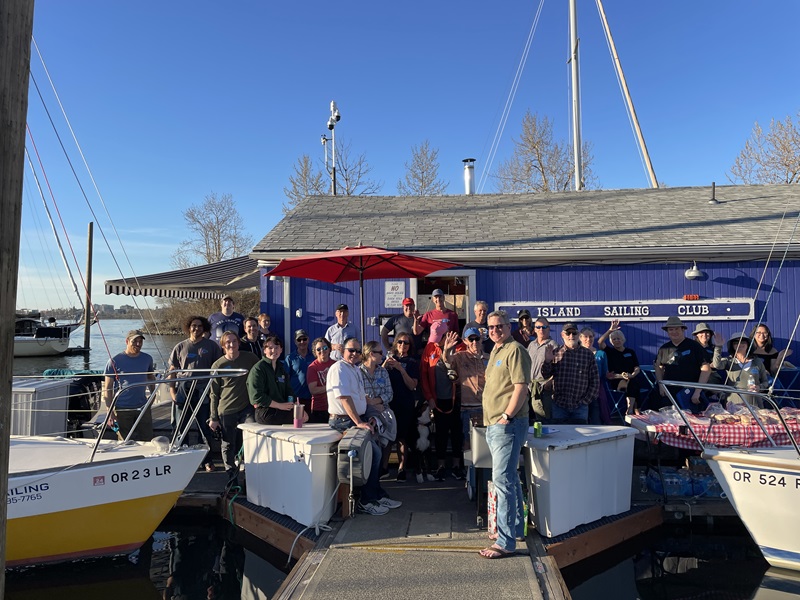
I joined the club back in the 90s and it was only a few months before I would start working at Island Sailing. When I was just another member looking for time on the water and people to sail with, one of the first things I noticed early on was an old clipboard on the wall with a pencil hanging from it and with handwritten names and phone numbers. No explanation, no system. Just an understanding: if you wanted to connect with other members to sail, you could call someone, and chances were good they’d say yes. I used that list quite a bit. Because of it, and because I belonged to the club, I sailed with people of different ages, backgrounds, and experience levels—and many of them became close friends.
Thirty years later what strikes me now, watching our performance and cruising groups growing and becoming more and more active, is how little that has changed. The tools look different, but the behavior is the same. For example, just like back then - on windy afternoons with tricky docking situations, someone steps up to offer assistance landing without fanfare. Experience differences are treated as normal, not notable. Help is offered quietly and without keeping score.
You’ve probably noticed how rarely anyone here is left to figure things out alone. Many of you have helped someone newer without ever thinking of it as a gesture—because here, it’s just how things are done.
In a world that often feels loud, divided, and demanding, the docks can be a rare kind of neutral ground. Here at Island Sailing - here, on the docks and on the water - what matters is showing up, paying attention, and taking care of one another and the boats we share. This isn’t a program or a policy. It’s a long-standing pattern of how members treat each other.
Island Sailing has always been a place where everyone is welcome—where differences are respected, learning happens at every level, and belonging is never something you have to prove or earn. We are so incredibly grateful to all of you: our members, for continuing to show up this way. This place works because belonging here is something we create together. Thus - we want to extend a heartfelt thank to you all.
|
|
|
|
|
|
|
|
|
|
As we move toward spring sailing, fleet care and seasonal preparation continue on schedule. Boats, docks, and systems are being tended to steadily and thoughtfully, with the same focus on reliability and stewardship that keeps everything running smoothly when the season picks up. The work is often quiet, but it matters—and it’s being handled.
This month also brings a meaningful transition for our community. Spencer Matthaei will be moving on to begin graduate school, likely in France. Spencer has been an exceptional part of Island Sailing—an instructor of rare skill, integrity, and presence, and a crew member who consistently elevated the experience for everyone around him. His calm judgment, professionalism, and care for both people and boats have left a lasting mark here. While we’ll miss having him here at the club, on the docks, and on the water, we’re proud to see him take this next step and look forward to staying in touch—and to future visits when he’s back in this part of the world.
At the same time, we’re excited to share that a new crew member will be joining us in the coming weeks. We’re very much looking forward to welcoming him into the community. He brings an uncommon depth of experience for his age—including a two-year circumnavigation completed just after college—and an energy we believe will be a great addition to Island Sailing. You’ll meet him and learn a bit about his voyages here below!
As always, our focus remains the same: taking care of the fleet, supporting one another, and creating a steady, welcoming place to sail. Things are moving forward—thoughtfully and with care.
|
|
|
|
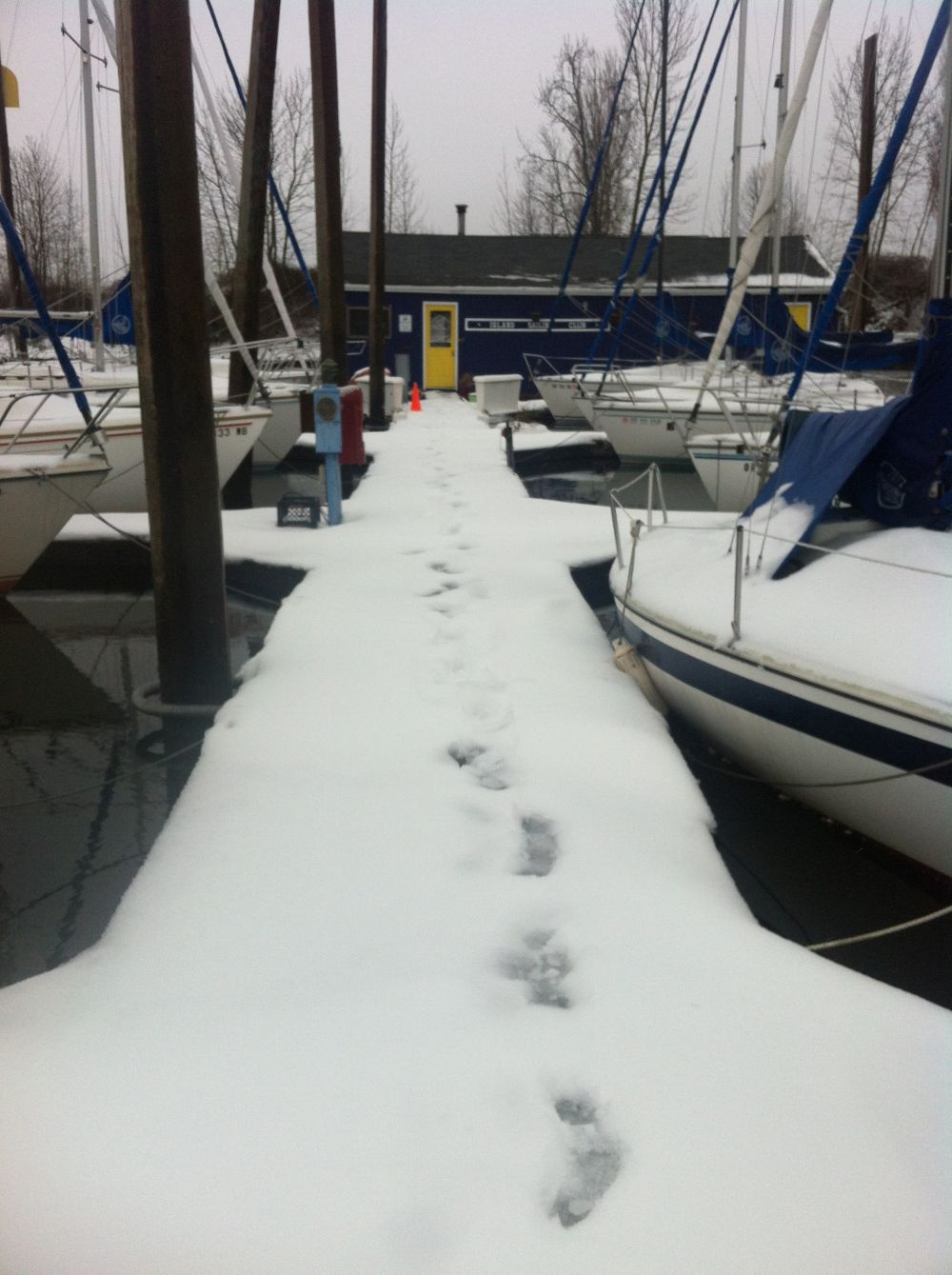
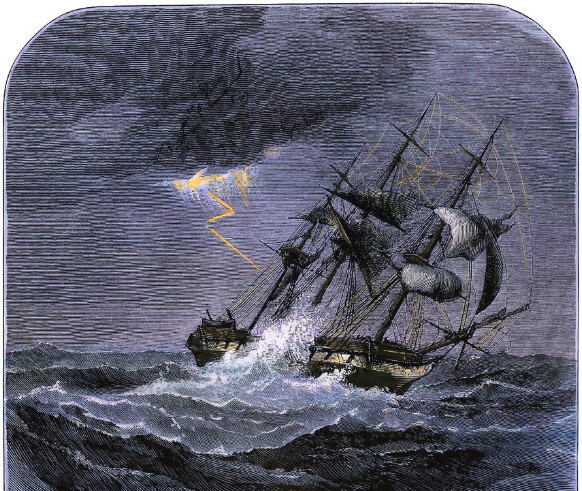
Fortunately, this is from another winter in a time long ago... | |
|
|
|
|
|
Seamanship and Your Fleet! |
|
|
|
Good seamanship is the opposite of being a "white knuckled driver". It is more than a list of do's and don'ts - it's not just a bunch of how to's - it is an attitude of approach. For a good sailor, as we are working to help you all become by being a part of Island Sailing, it informs how we approach everything. There are several phrases that you may hear as you spend more time around the club that capture the essence of what good seamanship is. A few for example: local knowledge is always the best knowledge; if there's two ways to do something and you find yourself doing it the riskier way, you better ask yourself why; always recognize your (and your boat's) limitations; always listen to your gut and talk about what "doesn't seem right or feel right". Just as an old sailor will tack (or gybe) in their mind when turning from the sidewalk to the walkway up to their house, good sailors will bring that sensibility of seamanship to everything they do. Thus this attitude informs how we care for our crew, our community, and our boats: "take care of your boat and your boat will take care of you". We, as the crew at Island Sailing know, when we are doing good work - your progression as a member and beginning sailor onward toward becoming and experienced sailor will include this attitude which of course emplies a healthy respect for the practice of good seamanship.
|
|
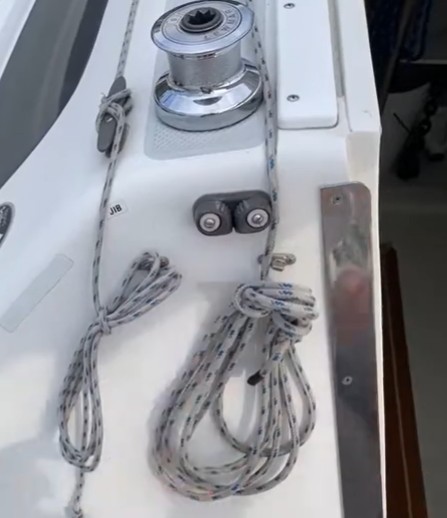
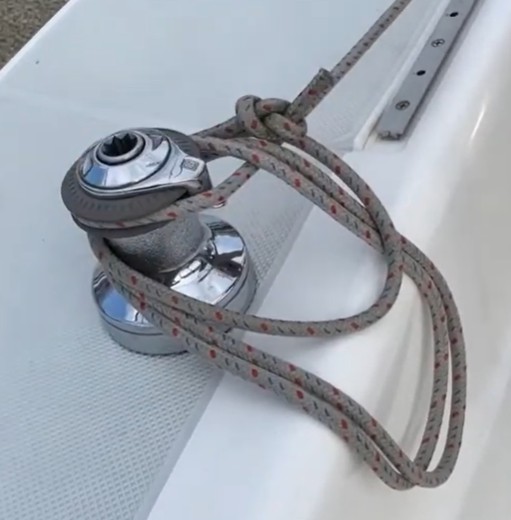
In that sense, we take on something larger together. As a community of sailors, we become stewards not only of a shared fleet, but of a long and proud tradition of good seamanship. One of the quiet strengths we’ve noticed—and something we’re genuinely proud of—is how, over the past few years, members have increasingly cared for the boats:
|
|
|
|
stowing gear thoughtfully, asking questions as they learn and progress, and paying closer attention to the small details that matter.
That habit, more than any checklist or rule, is what keeps the fleet reliable and in good shape for all of us who have access to it.
|
|
Seamanship certainly includes skills, procedures, do’s and don’ts, and best practices. But at its core—and we believe many of you are already beginning to recognize this—it’s an attitude.
It’s how you approach the boat, and prepare for the sail before you even leave the slip, and how you care for the boat when you stow everything once back.
|
|
|
|
Developing that mindset is one of the most important steps in becoming not just a more competent sailor, but a more experienced and trusted member of this community, and it’s something we hope to continue supporting you in as you grow with us.
|
|
|
|
|
|
|
|
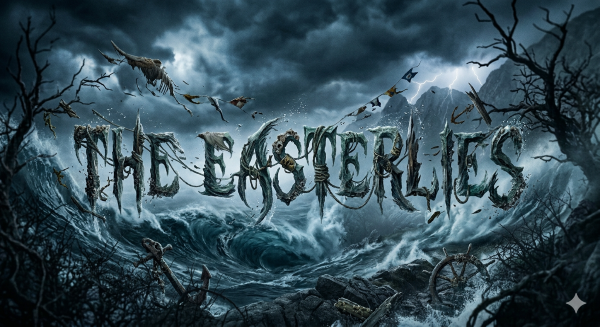
As we have these wonderful early spring conditions we can get some great sailing in for sure. There is however one local wind phenomenon you should certainly be aware of - THE EASTERLIES! These winds are wiley, not to be trusted, and always to be watched out for. As one of the most significant wind events we can get in this region, one should never turn their back on... THE EASTERLIES.
Forecasts are just that - forecasts. In other words, one must always judge, to go or not to go, to cut loose or not to cut loose, based on actual observed conditions at the time. After a certain point, looking at what various apps may be telling you or reporting, and looking at the forecasts, must be left aside. Instead - just standing at the edge of the dock, or out at the corner of the club deck looking out at the river - that should be when you make the final go no go choices. Forecasts for the easterlies can also be tricky. If they are forecast to last 2 to 3 days, you can be assured they are coming, and they will likely come in very strong. Generally speaking, the first day is often the strongest, the second a little less, and the third even less.
|
|
|
|
38 gusting over 40 Mph - 33 gusting over 36 in Kts. | |
|
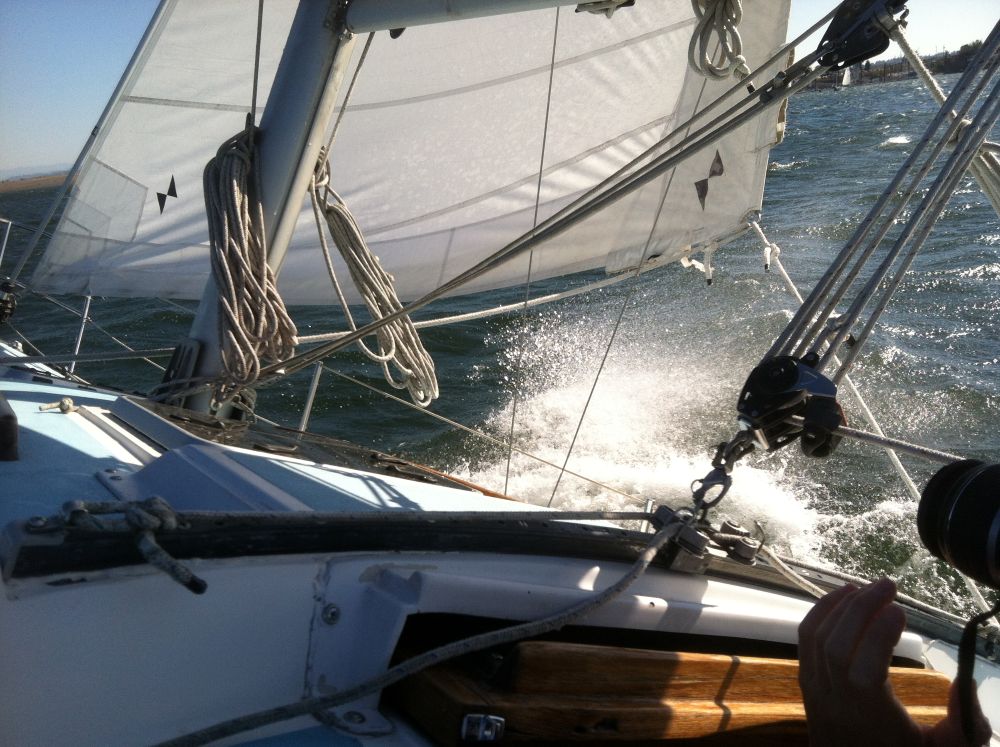
If they are forecast to start in the morning, they may... but they may not arrive until later morning or midday. Still, they may arrive right on time. Could be you are out for a morning sail enjoying some nice standard North Westerlies when you notice the wind dying. It often will completely die and you'll see your windex spinning around in circles as the boat rocks. What you may not notice is that the planes are landing in a different direction... because the upper level winds have already changed. This is when you had better watch out. Keep a very sharp eye up river, and be prepared. I have seen the Easterlies arrive as a wall of wind, truly a wild phenomenon. If you're not ready for them you will be completely overwhelmed. In these cases it can go from 0 to upwards of 25-30 mph immediately when they reach you! As a side note: winds on inland waters are forecasted and reported in mph. This is one of the very few 'cross overs' between nautical, or Knots 'Kts' and statute miles. Once on a sound or offshore connected waters, the measurements and conversation will be in Knots. 1 Kt is 1.15078 Mph so 25 Mph winds are just over 21.7 Kts. Our normal evening North westerlies can range between 15 to 20 Mph so between 13 to 17 Kts. That is a lot of wind, especially for the smaller boats, and it requires a decent bit of skill and competency to handle a boat in those winds. The North Westerlies are also more 'reasonable', in a way, more manageable whereas the Easterlies are surly, aggressive, and even kind of angry winds - relentless in a way. Say the forecast is for 15 to 25 Mph winds gusting 28 to 26... how these winds behave is there will be the relatively consistent winds at the lower intensity - already quite challenging conditions especially for a newer sailor, a small (or larger) boat, and for our waters. Then, just as you might think you're doing okay, if you watch upriver - to the east, where the winds are coming from, you'll suddenly notice a far darker patch with a lot more whitecaps working it's way down river toward you. These are the 'gusts'...
|
|
|
|
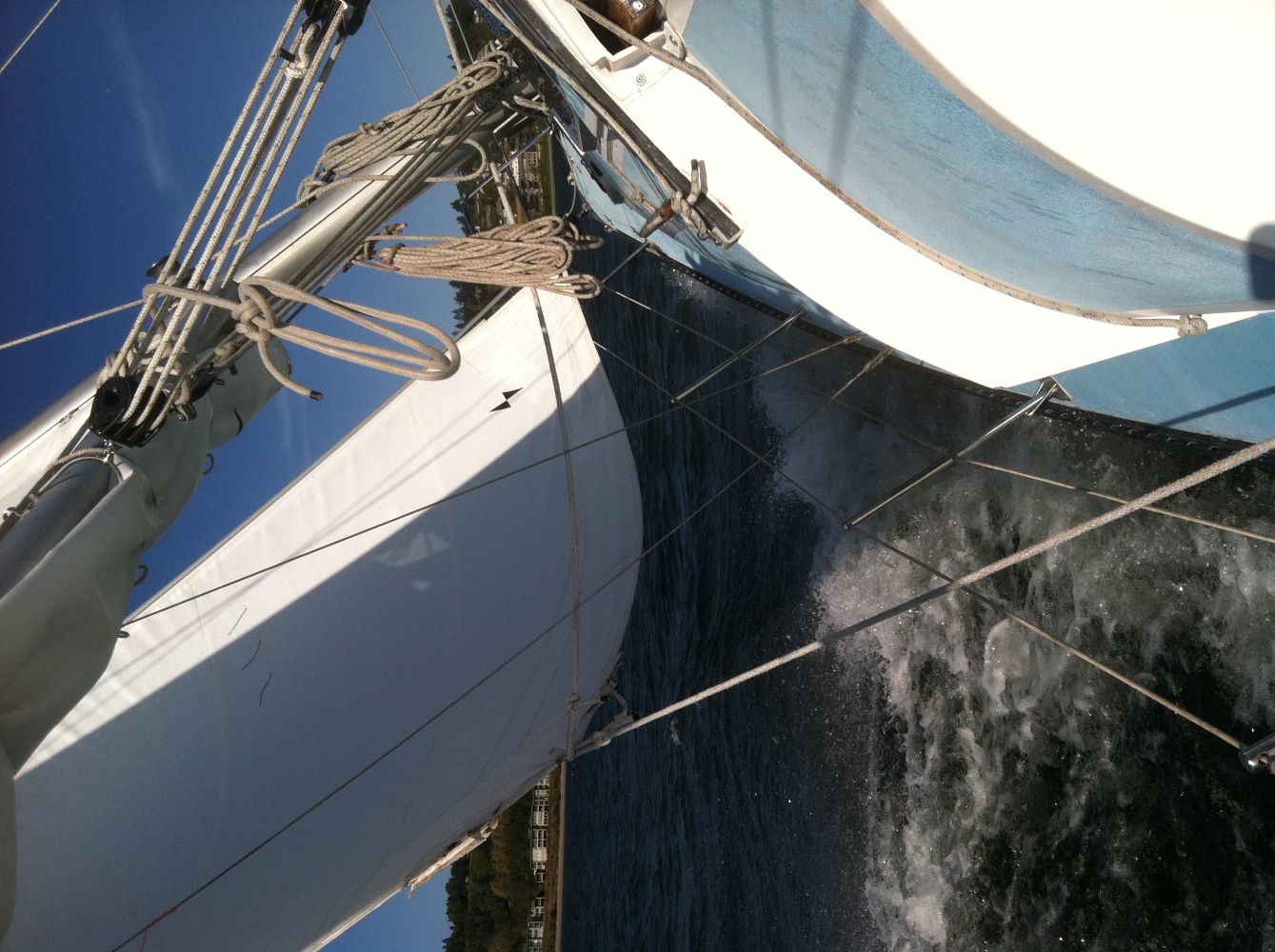
Unlike gusts in North Westerlies or even in Southerlies, these 'gusts' are sustained 'patches' of higher winds that can last for five, ten, or even fifteen minutes or more. It's in these gusts, or increases of wind, that you may experience winds well in excess of 30 to 35 or more mph conditions. This is a level of wind that can lead to very serious situations. You CAN NOT JIBE in these conditions; making any way to windward will be nearly impossible, every tack takes very good boat handling, and both the South and the North shore become lee shores. Bringing the bow through the wind for a tack in these conditions can be very difficult, and a missed tack (when you get blown back on to the tack you were on) can spell catastrophe. It is very difficult for us to take a simple approach in regard to potentially 'grounding' the fleet based on these forecasts before the conditions themselves actually happen. We, of course watch these forecasts very closely and will reach out through the reservation system to warn members of the potential, even calling folks on the day when necessary. When the east winds do come in full and are howling in the marina, we at times do have to simply shut the fleet down. Even docking and maneuvering in those conditions becomes almost untenable, not to mention how strong the winds will be out on the river at that point.
|
|
|
|
If you are caught out in those pending conditions we highly recommend that, when you see them coming you quickly get the motor running and drop sail so you'll be much better equipped to manuever as they arrive in the area where you are. We also recommend that you give us a call to watch for your arrival as we're always happy to help you land. Remember that most of our docking and maneuvering is in North Westerlies or Southerlies, and the Easterlies will present a whole new and different level of challenge. We will coach you from the dock during your approach and standby to assist, which can make all the difference for managing your approach and landing in what can quickly become challenging conditions, even inside the marina. So always 'keep a good weather eye' out, always review the forecasts right up until you go, always set the forecast aside once at the boat and observe the actual conditions before making the final go no go choices, and listen to your gut - if your instinct is to not try and cut loose, it's probably giving you pretty good and truly prudent advice.
|
|
|
|
|
|
|
|
|
|
|
|
~In honour of our past and diversity in America~
|
|
Superstitions of the Sea
How Diverse Crews Built a Shared Culture of Survival
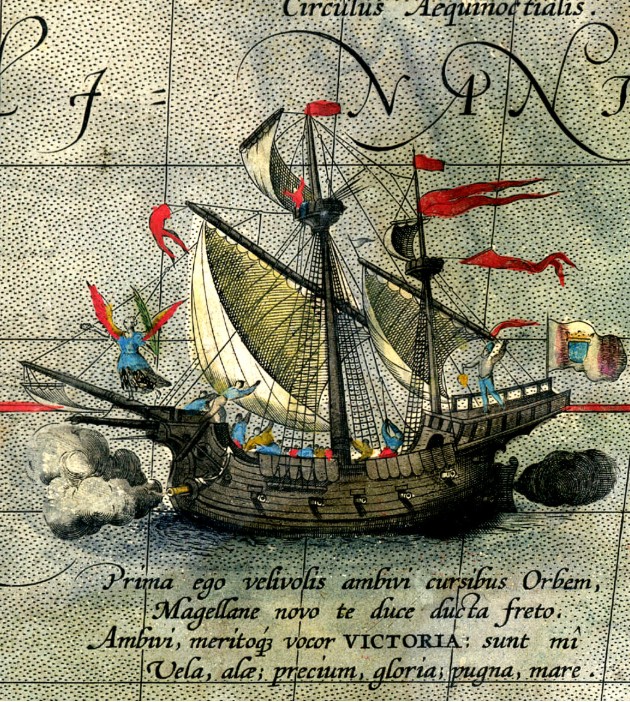
In the early sixteenth century, aboard ships such as the Tudor warship Mary Rose, a crew might include sailors from England, the Mediterranean, North Africa, and other regions tied together by the growing web of global trade. What united them was not nationality, language, or religion. It was the ocean—and the shared understanding that it could kill them at any moment.
For sailors of the Age of Exploration, life at sea was defined by uncertainty. Storms appeared suddenly. Hulls leaked. Navigation tools were crude by modern standards. A voyage might mean prosperity, discovery—or disappearance. In such an environment, sailors did what humans have always done when confronting overwhelming risk: they developed rituals and beliefs that gave them some sense of order and control.
Those beliefs became the famous superstitions of the sea.
|
|
A Multinational Culture at Sea
Long before modern conversations about diversity and inclusion, the maritime world was already profoundly multicultural. Merchant and naval ships routinely carried crews drawn from many different regions. Sailors often moved between fleets, ports, and nations, forming a mobile workforce defined more by skill than by origin.
Historian Marcus Rediker describes early modern ships as floating societies where sailors developed a shared working culture that transcended national identity.¹ Over time, the identity of sailor itself became a kind of international citizenship.
This multicultural environment produced a hybrid maritime culture—one that blended knowledge, language, traditions, and practices from many parts of the world.
|
|
|
|
|
|
Knowledge from Many Worlds
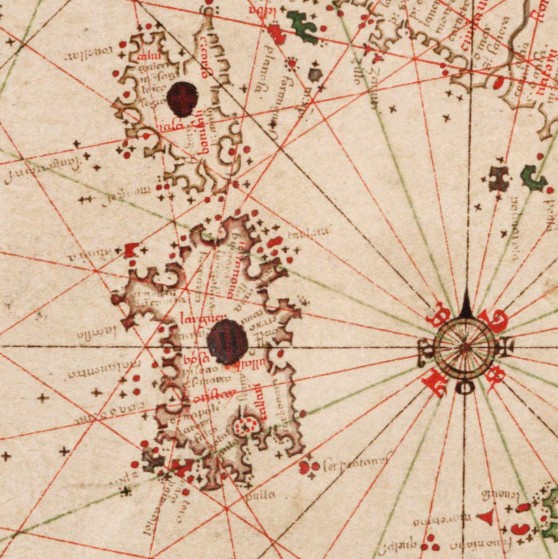
One of the clearest expressions of this cultural blending can be seen in the earliest nautical charts known as portolan charts.
Developed around the Mediterranean beginning in the 13th century, portolans were among the most detailed geographic documents of their time. But they were not the product of any single civilization. Instead, they were a synthesis of maritime knowledge gathered from sailors across cultures.
These charts combined:
-
Mediterranean pilot knowledge of coastlines and harbors
-
Islamic mathematical traditions used in navigation and calculation
-
Asian navigational practices, including refined compass use
-
European religious imagery and cosmology
The result was a practical tool built from shared human knowledge—one that allowed sailors from different cultures to navigate the same seas using a common reference point.²
|
|
|
|
Why Sailors Became Superstitious
The same environment that produced advanced navigation also produced an extraordinary number of superstitions.
From a psychological perspective, this makes perfect sense. When people operate in environments of extreme risk with limited control, rituals and symbolic beliefs can reduce anxiety and create a sense of influence over uncertain outcomes.³
For sailors, whose lives depended on wind, weather, and fragile wooden hulls, superstition became part of daily life.
Many famous maritime superstitions also had practical origins.
-
Whistling on deck was believed to stir up storms or “whistle up the wind.” In reality, unnecessary noise could disrupt communication during sail handling—potentially dangerous during maneuvers in heavy weather.
-
Rabbits and pigs were considered bad omens aboard ship. But rabbits could chew through rope or sailcloth, and pigs could destroy provisions—serious risks on long voyages.
-
Bananas on boats, still considered unlucky by some fishermen today, likely gained their reputation because bananas ripen rapidly and release ethylene gas, accelerating spoilage of nearby produce and attracting insects.⁴
Over time, practical experience hardened into tradition, and tradition became part of the shared identity of sailors.
|
|
|
|
A Shared Identity Forged by the Sea
What’s remarkable about maritime superstition is not that sailors believed strange things—it’s that these beliefs helped unite people from vastly different cultures.
A sailor from England, Spain, North Africa, or the Mediterranean might arrive aboard ship with very different religious beliefs or cultural traditions. But survival at sea required cooperation, trust, and a shared understanding of how to behave aboard the vessel.
Superstitions, rituals, and traditions became part of that shared language. They helped create cohesion among diverse crews who depended on each other for survival.
As maritime historian Margarette Lincoln notes, sailors developed a culture that transcended national boundaries and formed a unique seafaring identity.⁵
|
|
The Tradition Continues
Today, when we step aboard a boat at Island Sailing, we’re participating in a tradition that stretches back centuries. Sailors have always come from different backgrounds, cultures, and experiences—but the sea has a remarkable way of bringing people together.
Our community reflects that same spirit.
|
|
Walk down the dock and you’ll hear different stories, see different sailing journeys, and meet people who came to the water from all over the world.
But once the sails go up, we share something simple and powerful: We are sailors. And just like the crews who crossed oceans centuries ago, we learn from one another, rely on one another, and build something stronger together.
|
|
|
|
References
-
Rediker, Marcus. Between the Devil and the Deep Blue Sea: Merchant Seamen, Pirates, and the Anglo-American Maritime World, 1700–1750. Cambridge University Press, 1987.
-
Campbell, Tony. Portolan Charts from the Late Thirteenth Century to 1500. In The History of Cartography, Vol. 1. University of Chicago Press, 1987.
-
Malinowski, Bronisław. Magic, Science and Religion. Beacon Press, 1948.
-
Paull, Robert E. “Ethylene and Postharvest Handling of Tropical Fruit.” Postharvest Biology and Technology, 1999.
-
Lincoln, Margarette. British Pirates and Society, 1680–1730. Ashgate Publishing, 2014.
|
|
|
|
|
|
|
|
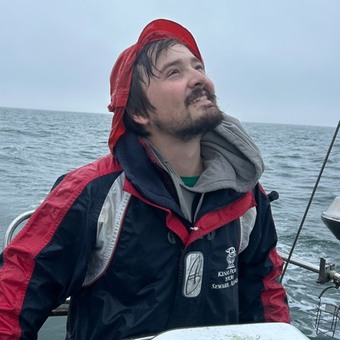
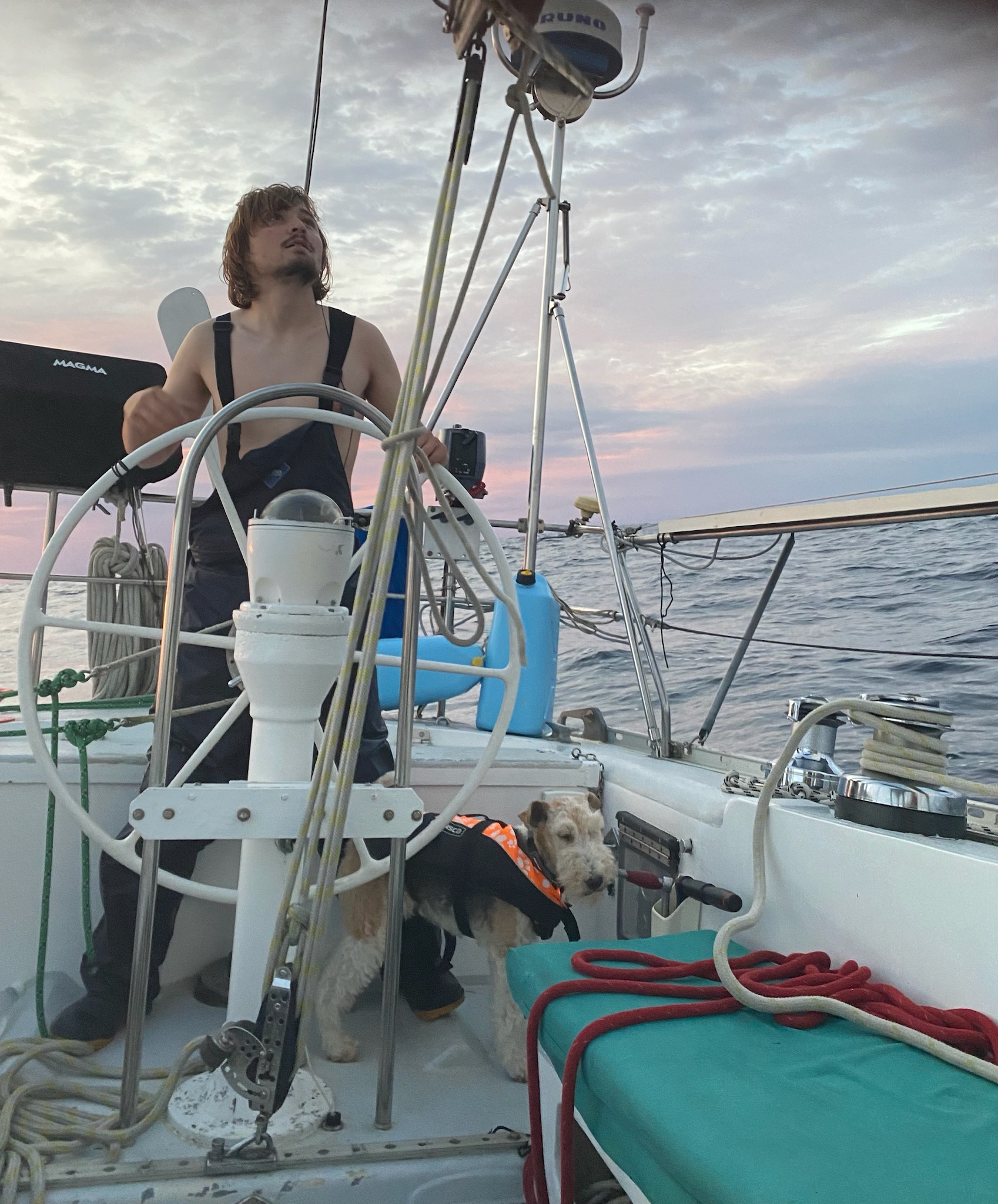
We would like to introduce our new crew member Trevor! Trevor comes to us with some tremendous experience in how he became and progressed as a sailor and we consider ourselves very fortunate to have him joining our crew. Some of you have already met him however he has some great stories to share about his voyages so we are including this article that he has written to share with all of you. |
|
|
|
|
|
|
|
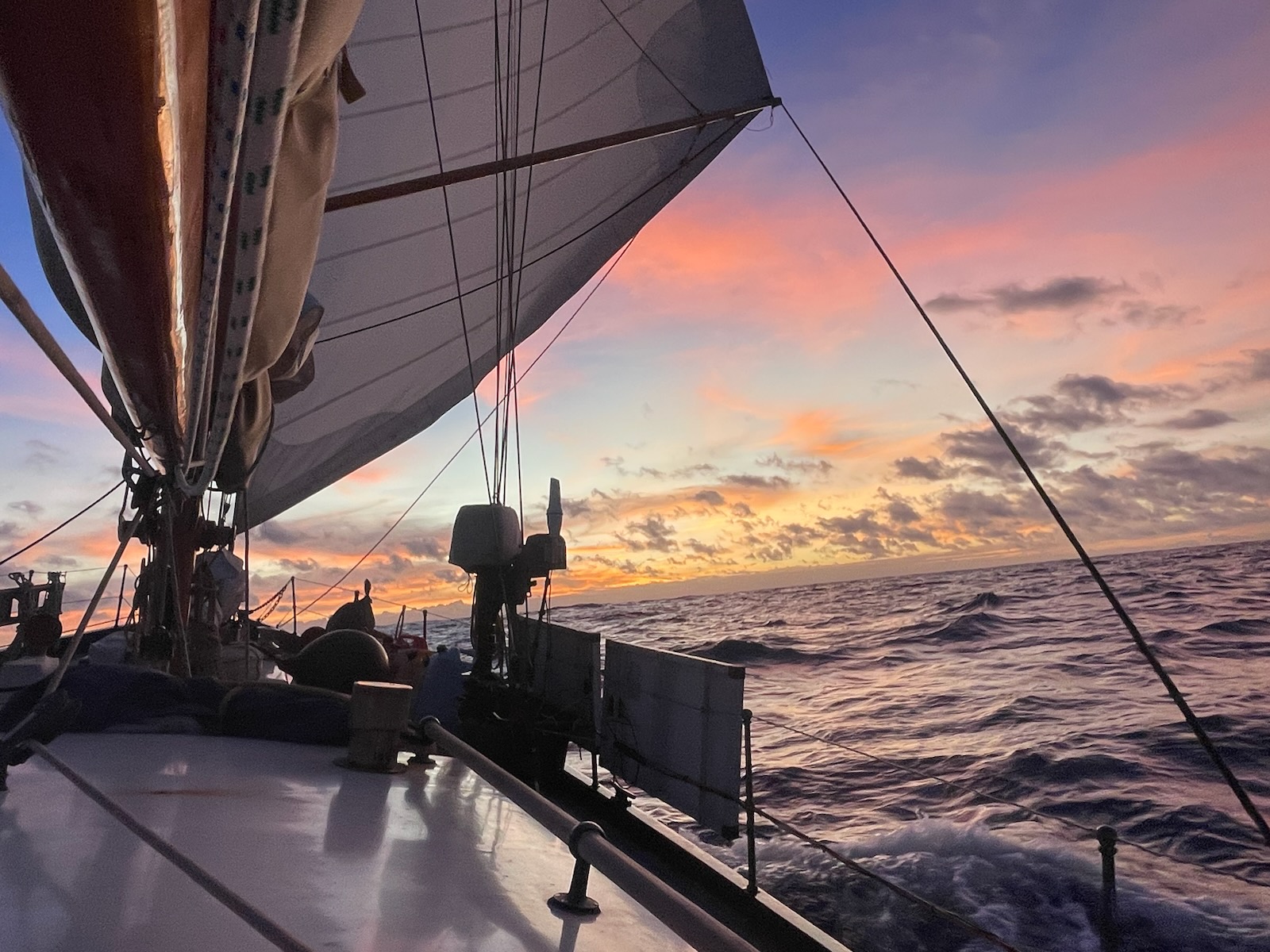
Those considering crossing an ocean by sail need be warned of two things. First, it is a miserable process of unceasing labor and perpetual tiredness. Second, it is an inescapable addiction which will take over your life and drastically redefine your priorities, whether you want it to or not.
The very first night, I got the distinct privilege of going forward to reef the main mid-squall. That was also when I learned that in a storm, my forty-something captain would take the wheel, the sixty something owner would hide below, and I would get to walk or crawl my way to the foredeck while the ocean collapsed on my back every few lurches. After doing it for the first time in my life with a solid 25 knots and an eight foot swell in the dark open sea, I learned why sailors swear. And crawling into my bunk that night taught me why they pray. If this was just night one, I was earnestly starting to wonder about my chances of ever getting to Australia.
|
|
I slept in my rain gear with a towel for a blanket. Water dripped on my head and body constantly and inconsistently. The lack of a lee cloth meant that I would fall out of 'bed' several times a night. The self-steering vane gave out less than four days out, meaning from then on it was 4-hour hand-steering shifts, or it would have been had they been distributed evenly. The old owner could barely take it, so pretty soon my 8-12 shifts were starting closer to 6. The day before we sighted land, the skipper handed each of us a full water bottle and told us it was all we had left to drink until our arrival in just under 200 nautical miles.
|
|
|
|
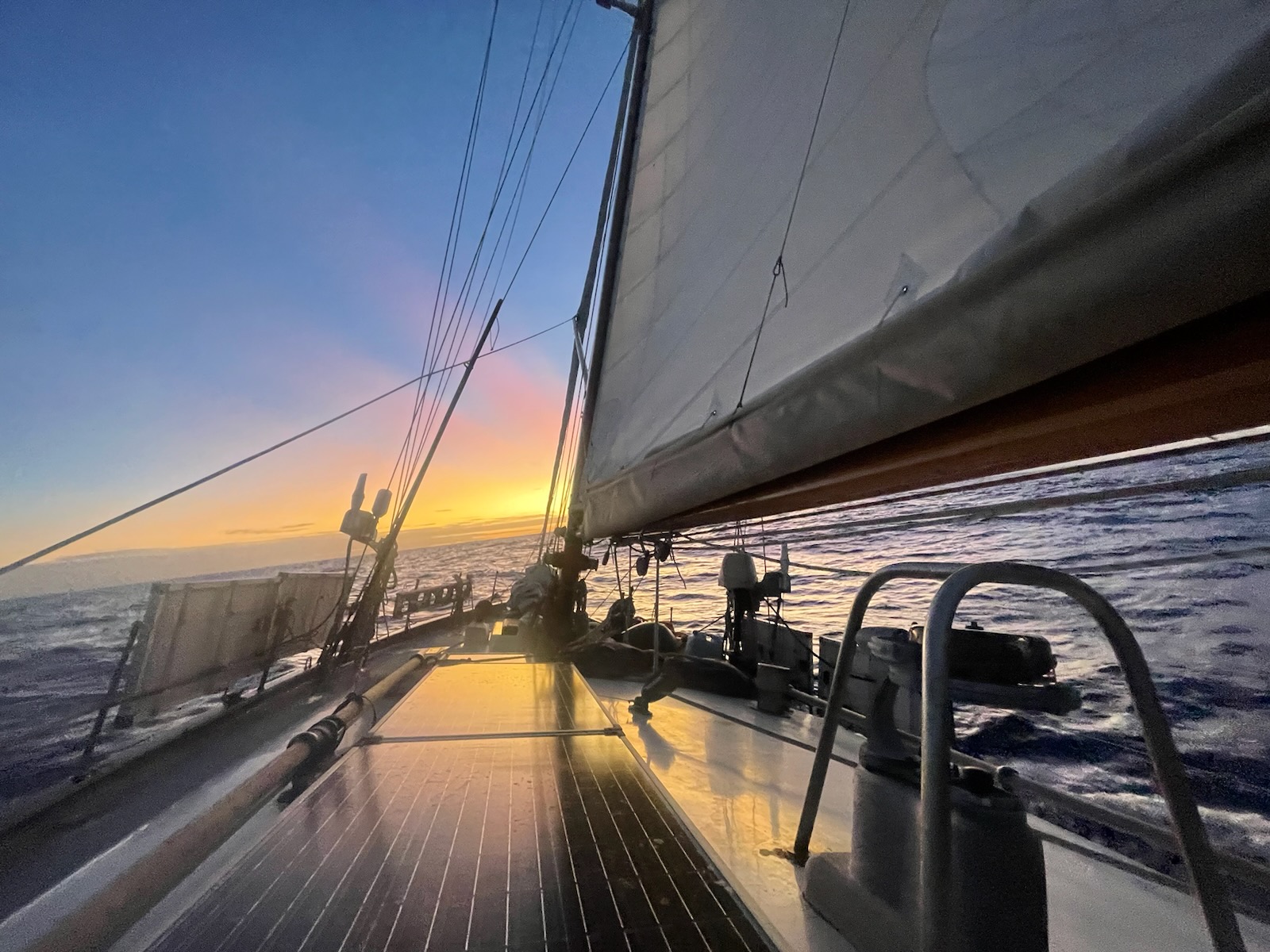
Around 10am on July 22nd, 2023, Fraser Island came into view. It was the first land I had seen in eleven days. Eleven days spent lamenting my stupidity, my hubris, my greed, everything that made me leave my wonderful life on safe dry land behind. Eleven days wondering if my last moments would be spent cold, wet, and alone, with nothing but myself, the ocean, and plenty of time to think of all the bad decisions which got me there. Land did in fact still exist, and it was right there in front of us.
Seeing land meant that we had made it, meant that from then until the day I die, I would be a person who had crossed the Tasman sea. A sailor.
|
|
|
|
I had caught the bug. After a couple months backpacking around Australia, I was ready to go to sea again, still not dreaming of sailing all the way home, just wanting to go sailing. But hopping from port to port in Indonesia I found myself inside the sailing community, swapping stories at each next bar and even dinghying over to other people's boats for drinks or dinner or just to say hi. As another person on a boat with a couple thousand sea miles, I was part of the club, part of the family.
|
|
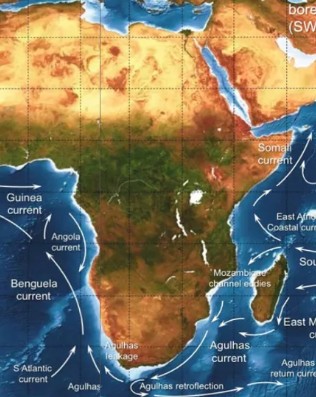
And so I met other boats, other captains going my way. Pretty soon I was bound for South Africa, racing alongside another boat that I knew could take me from there to Brazil, and then the dream took hold that I might someday sail all the way home from New Zealand. I was finally heading home, a year and a half after leaving New Zealand, I had boarded my last boat
|
|
which would take me from Grenada to Panama, from where I could overland my way straight back to California.
But this last boat wasn't just bound for Panama, they were going home to New Zealand. There was some internal debate when they asked if I wanted to cross yet another ocean with them, but ultimately there was never any real chance of me saying 'no' to a circumnavigation.
|
|
|
|
I had always felt this disconnect between the excitement omnipresent in movies, television, even historical fiction, and what it seemed like reality had planned for those alive today. The more I got older the more life seemed boring, the more my proscribed future seemed gray and plain. Heroic, exciting fiction could be a means to escape the monotony of the real world, but to believe reality could be anywhere near as exciting as fiction felt increasingly naive. Then I went to sea. 'Out there' I saw brighter bioluminescence than I'd ever dreamed of, more shooting stars in a night than I had seen my whole life until then. Sunsets and sunrises seen in their unspoiled perfection, the milky way shining just as bright as it did for the first humans to take to the sea. 'Out there' was a world so magical it could only logically be fiction, and yet I was there. It's the feeling of knowing some semblance the true grandeur of the universe, and seeing juxtaposed beside it one's own utter insignificance. Seeing the astoundingly long odds of being one of the few tiny specks in the universe which gets to look out at its enormity. Gratefullness is the only response. No matter how many times you dry off only to get immediately dumped on, how many long shifts you're barely clinging on to, how many dozens of things you break in the process of trying to fix something, the ridiculousness has a point. Get back out there. It's why sailing is the best teacher for life. There will be endless chores, miseries, annoyances and terrors, but ask any good captain or buddhist and they'll tell you the secret: Life is suffering. Find something worth suffering for.
|
|
|
|
Thank you Trevor for this fantastic article and for sharing a bit about your amazing sailing experiences! We're super happy to have you joining the Island Sailing Crew and Community! |
|
|
|
|
|
|
|
|
|
The temps are warming and the beginnings of spring are starting to....spring up! March brings some exciting events such as the launching of our Monday Night Performance Program races!
March 14th: RCYC Frostbite Race!
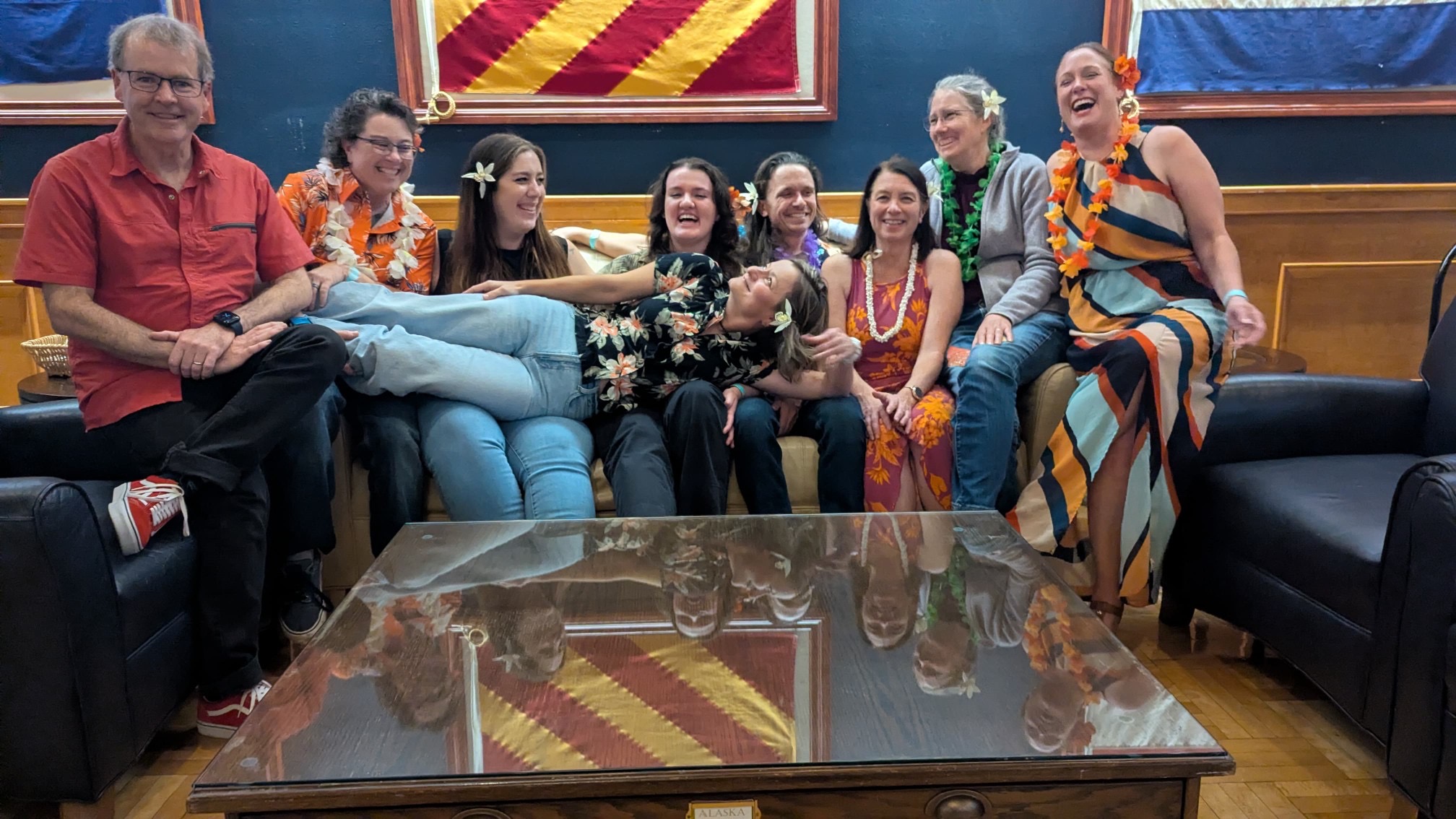
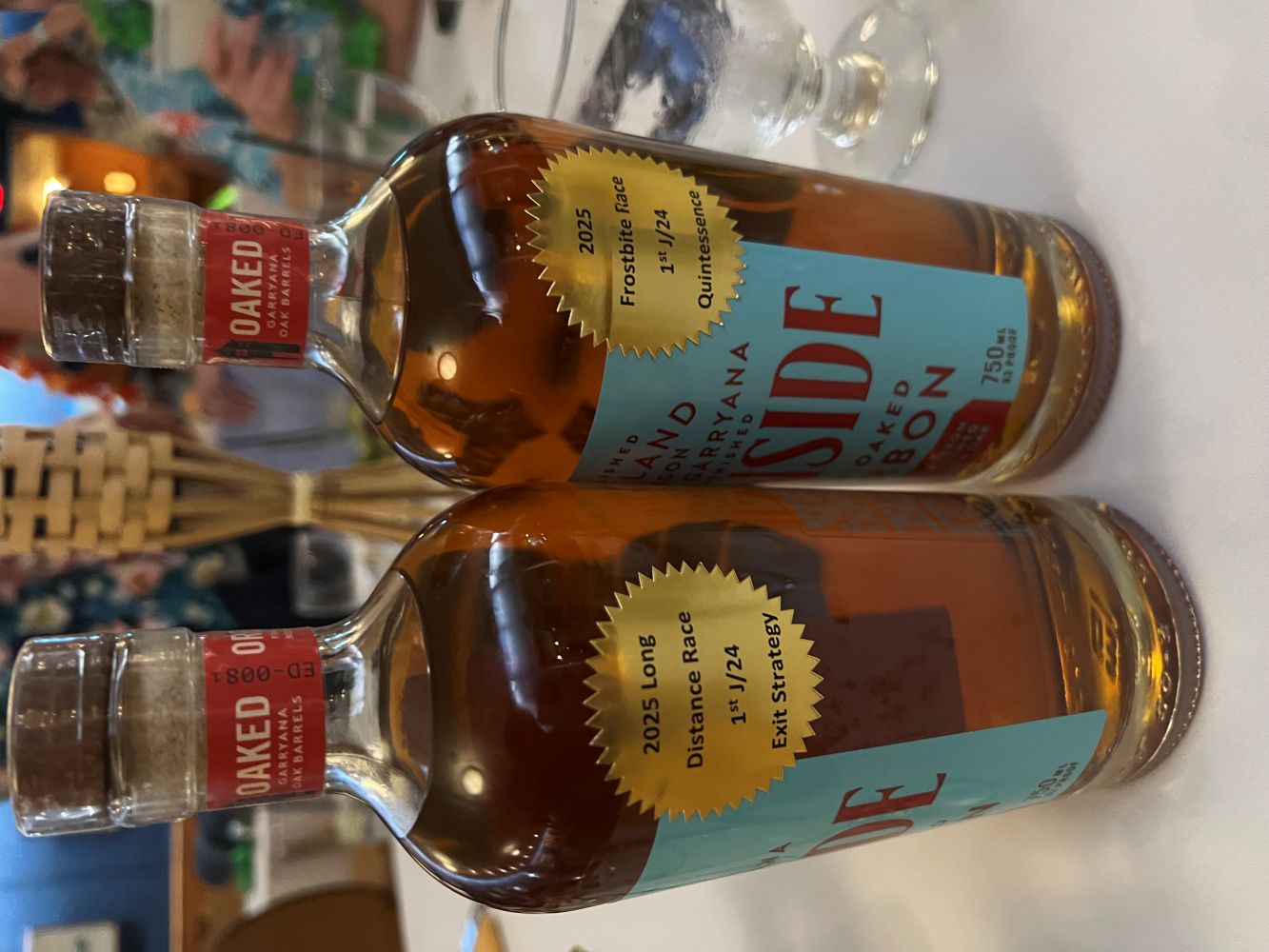
The annual Frostbite race is this month! Last year, our own Quintessence won the regatta in spectacular fashion crewed and skippered by our wonderful All Womens Crew (joined here by our great instructor and racing skipper Mark for the photo...) This photo is from the celebration at RCYC for Quin's win, alongside Exit Stratagy's win for the long distance race in the fall.
|
|
|
|
Congratulations to both crews! The Exit Strategy Crew for winning the Long Distance Race and the All Women's Crew for winning the Frostbite Regatta! |
|
|
|
March 16th, 6:00pm: Monday Night kickoff BBQ and Safety talk
Looking to get nerdy on racing rules? The season opener of our Monday night racing will consist of a cookout on the docks with a safety and rules talk for the upcoming season. This is a great way to get to know other sailors in our community and kick off the season with a bang!
March 23rd, 6:00pm: First Monday Night Regatta! - Its the first Monday race night full of the classic Kerry Poe coaching and Island Sailing spirit!
March 27th - 29th: Dave Perry Race Training Weekend - Want to take racing to the next level? PYC is hosting a series of seminars, workshops, on-the-water training exercises, and a practice regatta with the incredible Dave Perry. The 2020 National Sailing Hall of Fame inductee, and two time All American Sailor resume includes winning the US Match Racing Championship 5 times, winning the Congressional Cup twice, and winning class championships in the Soling, Tasar and Ideal 18’s. A great way to hone and improve your race craft ahead of the season. Want to get involved? Give us a call or a email for more information on registering!
Cruising Group Events: Wanting to keep an ear out for future Cruising events? Sign up on for our emails here, to be the first to hear about the next member adventure. The summer season is just starting to kick off, and events are beginning to ramp up.
|
|
To learn more and get involved CLICK BELOW!
|
|
|
|
|
|
|
|
As the horizon draws near... |
|
Looking back at the stories in this month’s newsletter—from the old clipboard on the wall to the history of multinational crews at sea—one thing becomes clear: sailing has always been about people as much as boats. Long before modern conversations about diversity, sailors from different countries, languages, traditions and cultures were already learning how to work together because the ocean required it. Cooperation wasn’t an abstract value; it was how crews survived and voyages succeeded. In many ways, that same quiet pattern continues on our docks today. Members help one another, knowledge flows naturally between experience levels, and people who may have arrived as strangers quickly become part of a shared community built around the water. At Island Sailing, this is also why diversity and inclusivity is one of our most important values we deeply believe in, seek to live by, and will always celebrate. |
|
Sailing has always brought together people from different backgrounds, experiences, and perspectives, and that diversity has always made sailors stronger. When people feel welcome and respected for who they are, they participate more fully, share knowledge more openly, and contribute to a healthier, more supportive environment for everyone.
|
|
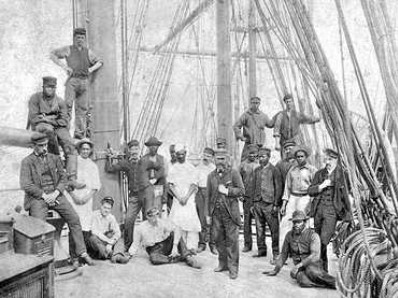
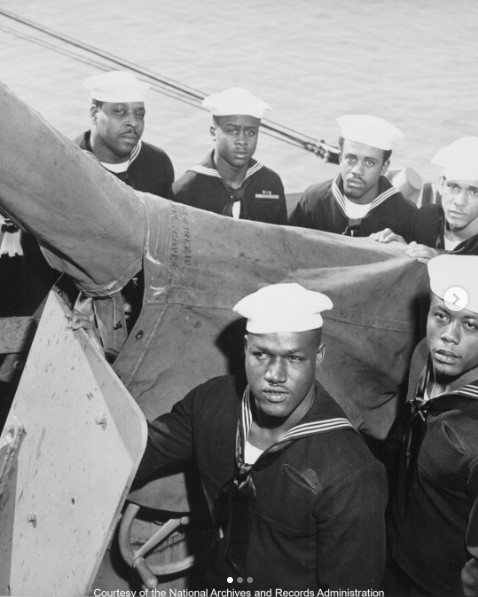
Our goal has always been to foster a space where people can show up as their authentic selves, where differences are valued, and where the simple act of helping one another on the dock or on the water reflects a deeper culture of respect and belonging. Image: Sailors who served in WW2 aboard The Intrepid - image courtesy of National Archives and Records Administration
|
|
|
|
|
|
From a broader perspective, this is also what makes membership communities work so well. People may initially join for access—to boats, classes, or time on the water—but they stay because of belonging. The real value of the club emerges through the relationships formed over time: the familiar faces on the dock, the spontaneous invitations to sail, the quiet mentorship that happens between more experienced sailors and those just starting out.
As Island Sailing continues to grow, that sense of community—and our commitment to diversity, inclusivity, and mutual respect—which makes us better and stronger as a country and as a community—will remain at the center of who we are. Thank you all for helping build and sustain a place where sailors from many walks of life can come and belong together and share something meaningful on the water.
|
|
|
|
|
|
|
|
|
|
Explore More - Learn More - Sail More And See Our Weather Links and - Check Out Our Youtube Channel! (Links on the bottom of our website) |
|
|
|
|
|
|
|
|
|
|
|
|
|
|
|
|
|
|
|
|
|
|

.jpg)
.jpg)